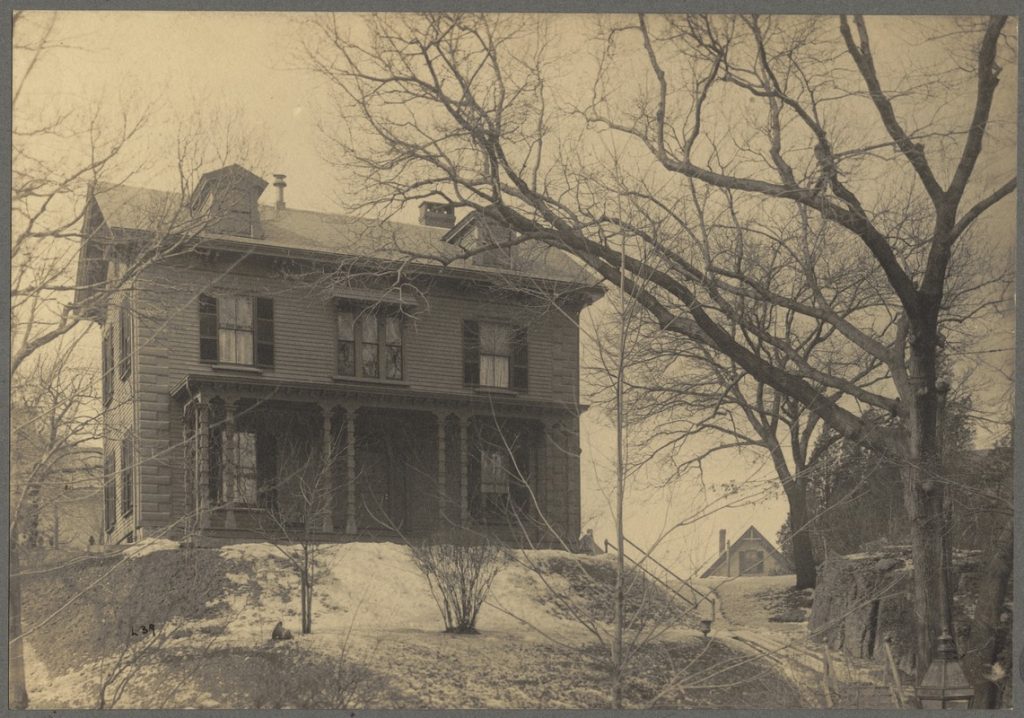
In 1864, William Lloyd Garrison, the famed abolitionist and publisher of the Boston-based, anti-slavery newspaper The Liberator, moved to the “Boston Highlands” of Roxbury with his family.
Rockledge was the name given to the half-acre estate. Due to the declining health and limited mobility of Garrison’s wife, Helen—an active abolitionist as well—it was thought best to move to what was then a relatively bucolic suburb. (The City of Boston did not annex Roxbury until 1868.) The Garrison family held onto the property until the deaths of both Helen (1876) and William (1879).
In an area today known as both Highland Park and Fort Hill, the original building, altered somewhat over the decades, and a later addition still stand. Beginning in 1904, Rockledge served as a nursing home, one run by the Episcopal Sisters of the Society of St. Margaret for low-income African-American women and children. Today, Rockledge, a National Historic Landmark, is part of Emmanuel College’s Notre Dame campus, where the 30 or so student residents dedicate themselves to community service and social justice.
Getting there:
Orange Line to Jackson Square Station. (0.6 mile, about a 14-minute walk.) The Emmanuel campus is accessed from Highland Avenue, a small street above and behind Rockledge.
Related site:
William Lloyd Garrison birthplace and family home, 3-5 School Street, Newburyport. (We explore this site in A People’s Guide to Greater Boston.)
Nearby:
Highland Park, former home of a Revolutionary War fort and the site of Fort Hill Tower, listed on the National Register of Historic Places. It affords a beautiful view of much of Boston.
To learn more:
Mayer, Henry. All on Fire: William Lloyd Garrison and the Abolition of Slavery, New York: St. Martin’s Griffin, 1998.
Boston Manufacturing Company in Waltham, 1978. Public domain.
The Charles River Museum of Industry and Innovation is housed in part what was of one of the first factories in the United States. It is also the site of the world’s first integrated factory—one in which all aspects of the manufacturing process are housed within a single entity. As such, many consider it the birthplace of the Industrial Revolution in the United States. It was there, in 1813, that Francis Cabot Lowell, a wealthy Bostonian, along with a group of investors that historians have called the Boston Associates (but who were never formally organized as such), established the Boston Manufacturing Company.
Producing cotton textiles, the factory relied on a workforce of approximately 300 laborers—largely young, unmarried women in its initial years—and on the energy provided by a small waterfall along the Charles River. The factory housed the country’s first power loom, the design of which Lowell had effectively stolen (and then adapted with the help of Paul Moody, a mechanic/engineer) from the mills of Manchester, England. In a stunning act of industrial espionage, he visited English factories and recorded to memory strongly guarded secrets and carried them back to the United States just before the War of 1812 broke out.
While wealth accumulation was certainly central to the goals of Lowell and his fellow investors, they had a larger social mission as well, one that grew out of their concern that the United States avoid the excesses of the English industrial experience in terms of filthy cities, urban poverty, and dire working conditions, and one modeled on a different approach to industrial development practiced in Scotland. Boston Manufacturing paid its employees in cash (rather than script, which was very common at the time) and, at least initially, at levels higher than prevailing wages for female workers (which were considerably less than those received by male workers). It also owned boarding houses in which its female workers stayed; the houses were staffed by a matron. As a way of instilling confidence in families who sent their daughters to work in Waltham, the company ensured the good moral standing of the women, enforcing standards of behavior and dress and requiring weekly attendance at church. While working conditions were not easy—12-hour days, six days a week in a room with lint-filled air—they were considerably better than those at factories elsewhere.
Over time, the logic of industrial capitalism undermined the pretense of any high-minded mission on the part of the Boston Manufacturing Company. In the face of rising competition in the textile industry, working conditions deteriorated at the Waltham factory as manifested by increased work assignments and lower wages. By the mid-1800s, the workforce was also characterized by a growing number of Irish (largely immigrant) laborers—many of them children.
What came to be known as the Waltham-Lowell system speaks to its geographic origins in so-called “Watch City” (as it grew rapidly, Waltham later became one of the world’s leading producers of watches) and the fact that it spread to what is now Lowell, Massachusetts.
Today, Waltham, which lies about 12 miles west of Downtown Boston, is a city of approximately 60,000. The Boston Manufacturing Company closed in 1930. The Charles River Museum of Industry and Innovation, which opened in 1988, tells the story of the company and of other aspects of Waltham’s industrial history.
Getting there:
Commuter rail from North Station (Framingham line), or MBTA bus from Downtown Boston, to Waltham Station. The museum is just below (going downhill) the station, on the Charles River, in the direction opposite that of the Waltham Common. Less than a five-minute walk.
Nearby sites of interest:
Waltham Common (across from the train station), the site of the annual Watch City Steampunk Festival (on the Saturday of Mother’s Day weekend), the largest such festival in New England.
Brandeis University, 415 South Street.
To learn more:
Robert F. Dalzell, Jr. Enterprising Elite: The Boston Associates and the World They Made, New York: W.W. Norton & Company, 1993.
Howard M. Gitelman. “The Waltham System and the Coming of the Irish,” Labor History, Vol. 8, No. 3, 1967: 227-253.
In 1970, Walpole State Prison was considered one of the most violent prisons in the United States. That same year, Francis Sargent, a liberal Republican dedicated to prison reform, won the Massachusetts governorship. In the aftermath of the prisoner rebellion and its bloody suppression at Attica in upstate New York in 1971, prison reform took on greater urgency in Massachusetts.
In this context, Sargent’s administration allowed members of the National Prisoners Reform Association (NPRA), a union of the incarcerated founded at a prison in Cranston, Rhode Island, to contact inmates at Walpole. Around the same time, two inmates, Ralph Hamm and Robert Dellelo, one Black and one White, were working to build a cross-racial alliance of Walpole prisoners. The pair would become the key organizers of a NPRA chapter at Walpole. The union was dedicated to racial justice, nonviolence, and prison abolition, and was effective at building alliances with political progressives outside the institution. Eventually, Walpole’s NPRA chapter won the right to engage in collective bargaining with the prison administration over labor issues as well as prison conditions.
In the face of growing prisoner power and an expansion of programs that lessened the incarcerated population, the guards’ union rebelled and walked off the job on March 14, 1973. For the next two months, the NPRA and its members—with the help of civilian observers—ran almost the entire prison, managing everything from the hospital to the kitchen while establishing a school and a conflict resolution process. One result was that levels of violence in the prison plummeted. Under political pressure, however, state authorities eventually and violently reasserted control of Walpole with returning guards aided by the state police, bringing an end to unprecedented experiment in prisoner self-determination.
Opened in 1956 to replace Charlestown State Prison, Walpole, a maximum-security facility, is today called MCI-Cedar Junction. It serves as the Massachusetts Department of Corrections’ “reception and diagnostic center” and, as such, receives all entering male prisoners in the state before they are assigned to another institution.
Getting there:
MBTA Commuter Rail to Walpole. The prison is 3.7 miles away.
To learn more:
Jamie Bissonette with Ralph Hamm. Robert Dellelo, and Edward Rodman, When the Prisoners Ran Walpole: A True Story in the Movement for Prison Abolition, Cambridge, Massachusetts: South End Press, 2008.
Wellesley College is a liberal arts college for women in the affluent town of Wellesley, about 19 miles west of downtown Boston. An elite institution, it has about 2,400 students and an endowment of almost $2 billion. Its alumnae association has been characterized as the world’s most powerful women’s network. Two out of the three women who have served as U.S. secretary of state (Madeline Albright and Hillary Clinton), for example, are graduates. Less well known is a Wellesley professor who worked to challenge war and militarism, at a high cost to her academic career, and who eventually won the Nobel Peace Prize: Emily Greene Balch.
Balch helped to found Denison House (part of the settlement house movement, and a site in A People’s Guide to Greater Boston) in Boston’s Chinatown in 1892, serving as its first headworker. After graduate studies, she became a professor at Wellesley and the chair of its Department of Economics and Sociology, teaching courses (from 1869 to 1918) on a variety of topics including the history of socialism, labor issues, immigration, and the economic role of women.
Balch was a strong supporter of worker rights and helped to found the Women’s Trade Union League. She self-identified as a socialist, while rejecting the notion of class struggle. An internationalist, feminist, Christian (first Unitarian and later Quaker), and pacifist, Balch attended the International Congress of Women at The Hague in 1915, as a U.S. delegate and helped found the Women’s International League for Peace and Freedom (which still exists today). Balch worked to end World War I through international mediation, while publicly opposing U.S. entry into the conflict and the military draft and supporting the rights of conscientious objectors and non-citizens. Her activism and the positions she took ultimately led Wellesley’s board of trustees to refuse to reappoint Balch, at 52, when her contract expired in 1918—despite her having the support of departmental colleagues and the College’s president.
After her firing from Wellesley, Balch continued her activism, particularly with the WILPF, and worked to oppose war as well as racism and imperialism—the U.S. occupation of Haiti (1915-1934) a key concern. In 1946, Balch received the Nobel Peace Prize “for her lifelong work for disarmament and peace.”
From 1898 to 1900, Emily Greene Balch lived on the Wellesley College campus at Stone Hall, a building destroyed by fire in 1927. On the same site now stands Stone-Davis Hall.
Balch died in Cambridge in 1961, at the age of 94. She is buried at Forest Hills Cemetery, two miles away from where she was raised (130 Prince Street) in Jamaica Plain.
Screenshot from The New York Times website. Photo caption reads: “Susan Shapiro standing outside Randolph, Mass., High School. ‘The flag don’t mean nothing,’ she said.”
On the second day of the 1984 school year, Randolph High School senior Susan Shapiro remained seated in her homeroom while her fellow students stood for the daily playing of the “Star Spangled Banner” and the recitation of the Pledge of Allegiance over the intercom system. Her homeroom teacher ordered Shapiro to stand. Motivated not by a particular politics, but by her view that the U.S. flag is an unimportant symbol which no one should be coerced to honor, Shapiro did stand that day. The next day, however, she invoked her constitutional right to stay in her seat.
Some students in the high school began insulting and taunting Shapiro as she continued her refusal to stand during the daily ritual. Meanwhile, some in the Randolph community fanned the flames. Gerald Rumbos, commander of the local Veterans of Foreign Wars chapter, for example, stated: “You can do anything you want in this country, but if you don’t stand up for the flag, you don’t belong in this country.” Matters intensified when, in November 1984, a local newspaper reported the story, which led to national media coverage. Shapiro and her family then became the targets of large amounts of hate mail and phone calls, many of them very threatening and overtly anti-Semitic. As such, her family pulled Susan out of school for fear of her safety.
Shapiro received support from many—including the American Civil Liberties Union, numerous Vietnam War veterans, and singer Joan Baez. She also had the backing of the U.S. Supreme Court: a 1943 decision (West Virginia State Board of Education v. Barnett) regarding the expulsion from school of a Jehovah’s Witness for refusing to salute the flag established that such refusal is a form of free speech.
A few weeks after the controversy exploded, Shapiro returned to Randolph High School. In the face of ongoing harassment, Shapiro’s parents filed a suit on her behalf—against her homeroom teacher, school officials, and the Town of Randolph—in the U.S. District Court in Boston seeking a court order affirming her right not to participate in the nationalist ritual.
In mid-June 1985, the superintendent of Randolph’s public school system and her homeroom teacher expressed regret for what had transpired. On the same day, the Shapiro family dropped the lawsuit, Susan’s right to refuse effectively upheld.
Getting there:
A MBTA bus from Ashmont Station (Red Line) stops close to the high school.
To learn more:
Nat Hentoff, Boston Boy, New York: Alfred A. Knopf, 1986.
Peter Mancusi, “Randolph Senior Drop Suit Against School and Town,” The Boston Globe, June 15, 1985.
The Charles Street Jail opened in 1851 as a facility that housed arrestees awaiting trial within Suffolk County. The building employed a reform-minded style which allowed for natural light and ventilation within the structure to provide an adequate quality of life for inmates. Over its many decades of existence, the jail held not only those accused of common crimes, but also many arrested for political reasons—including numerous women who demonstrated support for the suffrage amendment by protesting President Woodrow Wilson’s visit to Boston in 1919. Its better-known prisoners included Malcolm Little (Malcolm X), Nicola Sacco and Bartolomeo Vanzetti, Boston Mayor James Michael Curley, prisoners from two German U-boats during World War I, and William R. Baird Jr., a birth control activist.
Suffragists protest President Woodrow Wilson outside the Charles Street Jail, February 1919. Source: Historic New England.
In 1971, inmates sued the Suffolk County Sheriff and the Massachusetts Commissioner of Corrections for a violation of their constitutional rights due to the overcrowding in the jail. Federal Judge W. Arthur Garrity, best known for his desegregation decision (1974) in the Boston Public Schools, spent the night in the jail in 1973. His experience led him to declare the jail’s conditions unconstitutional and to order its closing. It wasn’t until 1990, however, that the jail closed and the prisoners were transferred to a new facility, the Suffolk County Jail, on Nashua Street.
What was the Charles Street Jail is now part of the Liberty Hotel, a luxury hotel owned by Massachusetts General Hospital and a site on the National Registry of Historic Places. The ironically named facility is centered around the jail’s circular rotunda surrounded by several levels of catwalks that used to connect the jail cells to one another; they now act as hallways between guestrooms, meeting rooms, and the hotel’s high-end restaurants and bars—ones with names such as Clink and the Alibi.
The Liberty Hotel Boston, former Charles Street Jail. Photo by Eleni Macrakis, August 2014.
Getting there:
Red Line to Charles/MGH Station. The site is across the street from the station.
Inmates of Suffolk County Jail v. J Kearney. 928 F 2d 33 (1991).
Walton, Krista. “Free at Last: A remarkable restoration transformed Boston’s notorious Charles Street Jail into the sparkling Liberty Hotel.” Preservation (September/October 2009).
The Charles Street AME Church when housed at the Charles St. Meeting House on Beacon Hill, circa 1889. Source: Boston Public Library, Digital Commonwealth.
An historic African Methodist Episcopal congregation, the Charles Street AME Church began in 1818, when a group of formerly enslaved people began meeting in a house on Beacon Hill and established the First African Methodist Episcopal Society. Leading up to the Civil War, the church served as a major meeting place for abolitionists and a key organizing site in the Boston abolitionist community’s fight against the 1850 Fugitive Slave Law.
Over its first several decades of existence, the church was located in various buildings in Beacon Hill. In 1876, its growing congregation, due in significant degree to a doubling of Boston’s Black population following the Civil War, led the church to move to the Charles Street Meeting House (at 70 Charles Street, on the corner of Mount Vernon Street) and take on its current name.
However, by the 1890s, the African American community in Beacon Hill was declining as families moved to the South End and Roxbury due to an influx of European immigrants to Boston and growing competition in both housing and employment. In order to accommodate its congregation, the church eventually decided to leave Beacon Hill, the last African American institution to do so, and move to Roxbury. Retaining its name, Charles Street AME bought the former St. Ansgarius Church property on 551 Warren Street and has resided there since 1939.
The Charles Street AME Church on Warren Street, 2014. Photo by Eleni Macrakis.
Getting there:
MBTA buses pass on Warren Street very close to the church.
Fort Independence, Castle Island, South Boston, 1884. Source: Boston Public Library, Digital Commonwealth, Creative Commons.
A huge explosion rocked South Boston in the early afternoon of December 6, 1898, shaking homes and breaking windows in the City Point area. In April of that year, the federal government had re-taken control of Castle Island (much of which is occupied by Fort Independence) from the Boston Park Department due to the Spanish-American War. This involved the U.S. military’s using of the island as a mine depot.
The imperial war had a geographically extensive and long-term impact—it was through the war that the United States colonized the Philippines, for example, Puerto Rico became a U.S. semi-colony, and Guantánamo a U.S. military base. However, the war as a whole was fairly brief: with the important exception of hostilities in the Philippines, which endured for over a decade, it only lasted three and a half months. So soon after deploying 256 mines to Castle Island, the Army began to decommission them. In the process of doing so, one of the mines exploded, killing four men.
The history of Castle Island and the series of forts (eight in number, the first one built in 1634) that have dominated it over time is a complicated one. One of the oldest fortified sites in what was Britain’s empire in North America, the 22-acre island is today a venue for recreation and relaxation. For much of its history, however, it played a significant role in militarily maintaining relationships of domination and subordination at home and abroad—from its use by British forces to control a rebellious population in colonial-era Boston to the deployment of troops from Fort Independence to enforce the return of at least one fugitive slave and the putting down of anti-draft riots during the Civil War in the North End. Perhaps the most famous solider ever stationed at Fort Independence was an 18-year-old named Edgar Allan Poe; in 1827, he spent five months on Castle Island. For a twenty-year period (1785-1805), the fort also served as a Massachusetts state prison.
Since 1892, Castle Island has been linked to South Boston proper—first by a wooden bridge and today a landfill. During the summer months, free tours of the fort take place on a regular basis during the day.
Fort Independence, on Castle Island, in the harbor approaches to Boston. Copyright (c) 2006 Chris Wood, Creative Commons.
Getting there:
Red Line to Andrew Station or Broadway Station. MBTA buses to Marine Park in the City Point neighborhood are available. Walk across Marine Park and around the lagoon to the fort.
To learn more:
Daniel Immerwahr, How to Hide an Empire: A History of the Greater United States, New York: Farrar, Straus and Giroux, 2019.
William J. Reid, Castle Island and Fort Independence, Boston: Trustees of the Public Library of the City of Boston, 1995.
Serena Zabin, The Boston Massacre: A Family History, Boston: Houghton Mifflin Harcourt, 2020.
For five days in March 1981, seventy-three physicians from the United States, Western Europe, and the Soviet Union met in Virginia, just outside Washington, D.C., to launch International Physicians for the Prevention of Nuclear War (IPPNW). In the preceding year, a trio of physicians affiliated with Harvard Medical School had begun conversations with medical counterparts in the Soviet Union. Despite their professional credentials, they were acutely away of their relative marginality in the context of a growing U.S. military buildup, Cold War tensions, and the election to the U.S. presidency of Ronald Reagan, which promised even steeper military spending. In this context, Bernard Lown, a cardiologist, and his colleagues carefully crafted a message based on their competency as physicians: “we must stick unswervingly to the medical facts about nuclear war,” they stated.
Lown and his colleagues first met in Geneva with a group of Soviet medical practitioners in December 1980. After a difficult start, their deliberations concluded with a call for the 1981 meeting. Although intimidated by the prospects of organizing an international gathering in just three months, the doctors set up shop in the Longwood area of the Fenway, in a small, 2nd floor office above Sparr’s Drug, a provider of medical supplies and equipment and an old-style drugstore with soda fountains. There they turned to a volunteer corps of a dozen Harvard Medical School students and raised over $250,000 to pull off the Virginia conference.
The gathering ended with appeals to fellow physicians, leaders of the United Nations, and the Soviet and U.S. leaderships, each premised in the “abiding faith in the concept that what humanity creates, humanity can control.” Arguing against the Reagan Administration’s perspective, they stated the nuclear war was unwinnable and catastrophic, and further, that international cooperation was needed to reduce nuclear stockpiles. IPPNW’s influence continued to grow alongside that era’s burgeoning anti-nuclear movement. The organization won international recognition, including the Nobel Peace Prize in 1985.
Parker Brothers is a well-known game company established in Salem in 1883, by siblings George, Charles, and Edward Parker. As the company grew, it purchased the property at 190 Bridge Street where it eventually built a 35,000-square-foot facility that housed its factory and offices.
Parker Brothers’ most famous game was, and remains, Monopoly. While many credit Charles Brace Darrow with the game’s invention (Parker Brothers purchased the rights to it from him in 1935), Elizabeth Magie (later Magie Phillips) first devised it.
Magie’s version, which she called “The Landlord’s Game,” grew out of her progressive politics. Indeed, she designed the game as a protest against the monopolistic practices of the likes of John D. Rockefeller and Andrew Carnegie. A student of the writings of the 19th century political-economist Henry George, who argued that natural resources—including land—should belong equally to all, Magie patented the game in 1903, hoping that it would teach people the importance of sharing wealth. Unfortunately for Magie, Darrow’s capitalistic adaptation of the game captured the attention of many more people and it was he who made millions from the game’s purchase by Parker Brothers.
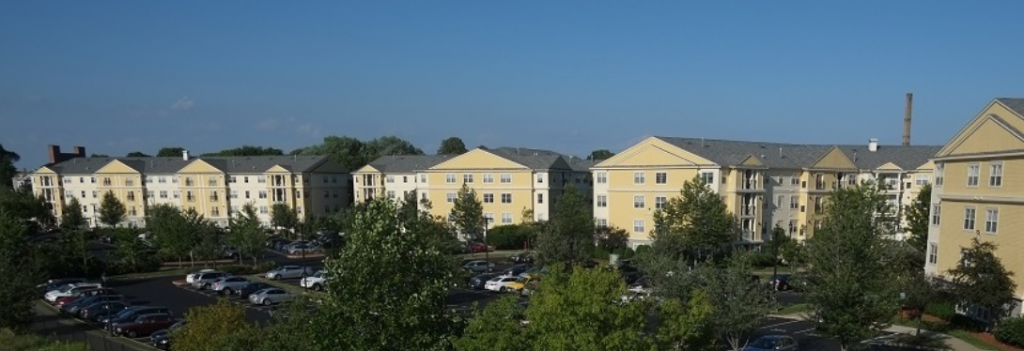
Hasbro bought Parker Brothers in 1991 and closed down the factory soon thereafter, tearing it down in 1994. It is now the site of an apartment complex.
Former site of Parker Brothers Headquarters, as seem from Salem Commuter Rail Station, July 2015.
Getting there:
MBTA Commuter Rail (from North Station) to Salem. MBTA bus from Orient Heights Station on the Blue Line.