John Greenleaf Whittier Birthplace

305 Whittier Road, Haverhill

A vibrant and complex cluster of abolitionists emerged out of Haverhill in the 1800s. They included Sydney Howard Gay, future editor of the National Anti-Slavery Standard and partisan of the Underground Railroad. Perhaps the best known was John Greenleaf Whittier, who gained national prominence as the author of Snow-Bound, a bestselling poem. Published in book form in 1866, the poem celebrated the disappearing New England family farm.

Whittier, born in 1807, was educated at a local Quaker school led by an influential abolitionist minister, Joshua Coffin. It was in a newspaper edited by William Lloyd Garrison (see our entry on Rockledge), the Newburyport Free Press, in which Whittier’s first published poem appeared, in 1826.

John Greenleaf Whittier birthplace, 2016. Photo by Suren Moodliar.

Whittier was ambivalent about his hometown’s best-known contribution to abolitionism, the famous Haverhill petition. In 1841, John Quincy Adams, the former president and member of the U.S. House of Representatives, presented the petition to Congress. It called for the dissolution of the United States, in effect Northern secession, claiming that taxpayers in the North were footing the bill for the defense of slavery in the South. Whittier was quite troubled by this tactic, fearing that if it were to succeed, slavery would remain intact. Despite this difference, Whittier remained a strong advocate of using formal political institutions to challenge slavery.

Built in 1688, Whittier’s birthplace still stands; today, it is a museum dedicated to the poet. The Whittier family homestead is open to the public from May until October via guided tours. The neighboring properties retain much of the bucolic character of Whittier’s time.

Plaque attached to the house where John Greenleaf Whittier was born. Photo by Midnightdreary, 2008. Creative Commons.

Getting there:

The home is 4.2 miles from the Haverhill Commuter Rail Station.
To learn more:

Christopher Klein, “Touring John Greenleaf Whittier’s birthplace and home,” The Boston Globe, October 6, 2011.

Whittier Birthplace website.

First Town House/Old State House

206 Washington Street, Downtown Boston

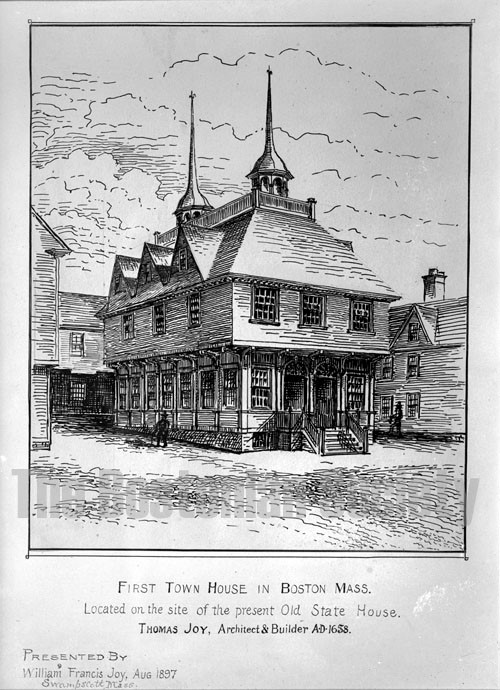
The First Town House opened in 1658. The wood frame building served as Boston’s town hall and the colonial seat of government. The building had a public market on the first floor. It also hosted legislative meetings and receptions by colonial officials and prominent Bostonians. In addition, it housed Boston’s first public library.

Illustration of First Town House, 1897. Source: Digital Collections and Archives, Tufts University (Boston Streets collection).

On December 25, 1686, Sir Edmund Andros, the royal governor of the Dominion of New England, attended two religious services at First Town House celebrating Christmas. British soldiers flanked Andros as the recently appointed official feared protests by opponents of the Christian holiday. The Puritans saw Christmas as little more than a pagan festival, with origins in the celebration of the winter solstice, dressed up in religious garb. Moreover, Christmas often involved behavior that Massachusetts Puritans perceived as antithetical to respect for Christ’s birth—“rowdy public displays of excessive eating and drinking, the mockery of established authority, aggressive begging (often involving the threat of doing harm), and even the invasion of wealthy homes” in the words of historian Steven Nissenbaum. As the highly influential religious leader Cotton Mather said to his adherents in 1712, “the feast of Christ’s nativity is spent in reveling, dicing, carding, masking, and in all licentious liberty…by mad mirth, by long eating, by hard drinking, by lewd gaming, by rude reveling!”

In 1659, about 27 years prior to Governor Andros’s attendance at the religious ceremonies at First Town House, the Massachusetts Bay Colony criminalized the celebration of Christmas, imposing a five shilling fine on those who violated the law. In 1681, however, Massachusetts rescinded numerous puritanical laws, including the ban on Christmas, in response to political pressure from Britain. Still, through the early decades of the 1800s, businesses and schools in Massachusetts did not close for Christmas, and many churches did not open. It was not until 1856 that Christmas became a public holiday in the state.

A huge fire destroyed the First Town House in 1711. Two years later, the Old State House, which still stands, was built on the site.

Getting there:

MBTA Orange or Blue Line to State station.

To learn more:

Christopher Klein, “When Massachusetts Banned Christmas,” History.com, December 22, 2015.

Steven Nissenbaum, The Battle for Christmas: A Cultural History of America’s Most Cherished Holiday, New York: Vintage Books, 1997.

Hugh Morrison, Early American Architecture from the First Colonial Settlements to the National Period, New York: Oxford University Press (88-89), 1952.

Staff, “When Americans Banned Christmas, The Week, January 8, 2015.

Bussey Bridge

South Street at Archdale Street, Roslindale

On March 14, 1887, the 7:00am commuter train left Roslindale station on its way to the Forest Hills stop. On board were somewhere between 200 and 300 passengers. As the train crossed the Bussey Bridge, the iron structure gave way and the passenger cars fell 40 feet or more (estimates vary) right through the bridge, killing at least 23 people and injuring more than 100 others.

Caption of illustration: “Massachusetts – the recent disaster at Forest Hills, on the Boston and Providence Railway – extricating the killed and injured immediately after the accident. Taken from a photo by D.W. Butterfield, Cambridgeport, Mass.” Source: Digital Commonwealth.

The Bussey Bridge was originally made of wooden trusses that were coated with tin for reasons of fire prevention, earning it the nickname “Tin Bridge.” By 1876, however, the entire bridge was made of iron. Following the fatal tragedy of 1887, an official investigation determined that bridge had been improperly designed and manufactured, and that it had gradually weakened from heavy usage. The Massachusetts Board of Railroad Commissioners also concluded that the Boston and Providence Railroad Company had been negligent in its managerial and inspection responsibilities. As a result of the disaster, railroad inspection regulations greatly improved across the country.

The wreckage also attracted a great number of viewers. Some claim that the viewing subsequently led many to decide to move to the area due to its beauty, thus spurring the growth of Roslindale.

Today, the rebuilt bridge, now made of cement and stone, stands as a memorial to the victims. The year of the accident, 1887, is engraved at the top of the bridge, and a small plaque explaining the event hides in the shadows on the left side (on the abutment) of the bridge on the Washington Street side.

Bussey Bridge, Summer 2014. Photo by Eleni Macrakis.

Getting there:

Orange Line or MBTA bus to Forest Hills Station. (0.8 miles, about a 16-minute walk.)

To learn more:

Boston 200 Corporation. Roslindale. Boston, Boston 200 Corporation, 1975.

Larry Pletcher, Massachusetts Disasters: True Stories of Tragedy and Survival. Guilford, Connecticut: Morris Book Publishing, 2006.

Anthony Sammarco, Roslindale. Charleston, South Carolina: Arcadia Publishing, 1997.

Massachusetts Board of Railroad Commissioners, Special Report by the Massachusetts Board of Railroad Commissioners to the Legislature in relation to the Disaster on Monday, March 14, 1887 on the Dedham Branch of the Boston and Providence Railroad. Boston: Wright and Potter Printing Co., State Printers, 1887.

Edward J. Sweeney, “Bussey Bridge Train Disaster,” Yankee Magazine, Vol. 39, No. 3. March 1975.

Pilgrim Nuclear Power Station

600 Rocky Hill Road, Plymouth

HD.6B.365 (11856585806).jpg
Boston Edison Company’s Pilgrim Station Unit 1, circa 1972. Public domain.

On New Year’s Eve, 1988, Diane Turco was preparing for evening guests, but decided to join friends protesting the imminent restarting of the Pilgrim Nuclear Power Station. (The U.S. Nuclear Regulatory Commission had forced the plant to shut down in 1986 because of many safety violations.) By that evening, Turco was sitting in jail, having joined 34 other activists in refusing to obey a police order to remain across the road from the plant. The arrested were soon released on their own recognizances, however. Indeed, even some of the police were sympathetic: one activist recalls an officer saying, “Thank you for doing this because we know this place isn’t safe and we could never evacuate the people [if there was an accident].”

Members of Cape Downwinders, an organization that Diane Turco co-founded in the mid-1980s, protest Pilgrim Nuclear Power Station, circa 2013. Source: The Patch.

Built by the Bechtel Corporation for Boston Edison, the station came online in 1972. Very soon thereafter, Boston Edison announced that it would expand the plant. In response, the Plymouth County Nuclear Information Center, or PICNIC, emerged to organize against the expansion and for closing the already existing station. Community resistance waxed and waned over the years in the form of various organizations. Nonetheless, activist efforts frustrated the plans of expansion in the case of Edison and renewal in the case of Entergy, a power company based in New Orleans, Louisiana which took ownership of the plant in the late 1990s, during the Clinton-era deregulation of energy. Community protest and advocacy also dramatically strengthened safety measures and public awareness through dogged litigation, protest, and educational activities. Although public health studies revealed that cancer rates increased with proximity to the plant, it was only after Japan’s Fukushima disaster 2011, and uncertainty about the plant’s economic viability in light of strengthening safety standards that, in 2016, Entergy announced that it would decommission the plant. On May 31, 2019, the plant closed down.

These developments notwithstanding, many are very concerned about nuclear waste that remains on site. There is also alarm at the deteriorating condition of its containment and the fact that the waste storage vessels are located just above sea-level. These will remain radioactive for millennia as well as exposed to rising sea levels and storm surges.

Getting there:

About 7.5 miles south of the Commuter Rail station in Plymouth.

To learn more:

Bruce Gellerman and Robin Lubbock, “Photos: Pilgrim Nuclear Power Station Shuts Down,” WBUR, May 31, 2019.

Miriam Wasser, “Pilgrims: 50 Years of Anti-nuclear Mass,” Boston Institute for Nonprofit Journalism, March 3, 2018.

Copley Square Hotel

47 Huntington Avenue, Back Bay

https://lostnewengland.com/wp-content/uploads/2016/01/770_1909c-loc.jpg
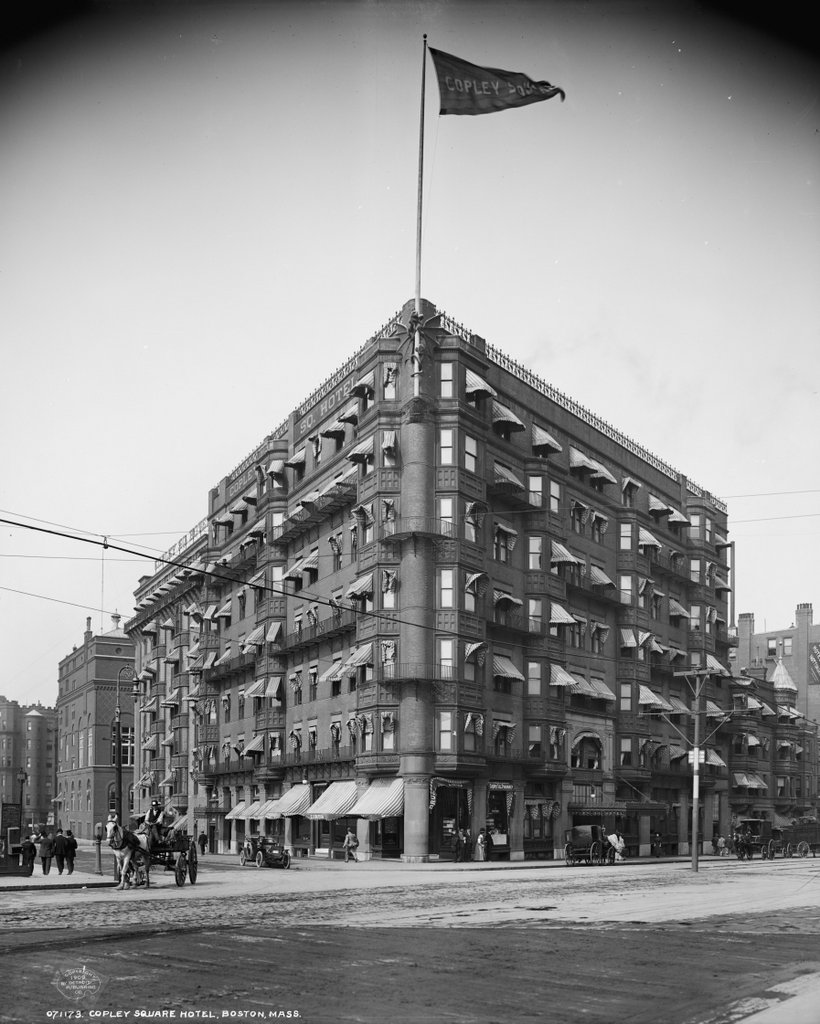
Copley Square Hotel, circa 1909. Source: Library of Congress.

When it opened on July 4, 1891, the Copley Square Hotel was the first and only hotel in the Back Bay. In 1896, the hotel served as the campaign headquarters for then-presidential candidate William McKinley. During the 1940s, the hotel housed the Storyville Jazz Club, which hosted, among others, the famed Duke Ellington, Billie Holiday, and Ella Fitzgerald. Less known is the occupant of a second-floor suite from 1939 to 1942: the New England chapter of the Christian Front and its leader, Francis Moran, an agent of Nazi Germany.

Father Charles Coughlin, the antisemitic and fascistic priest from Detroit whose weekly radio broadcasts enjoyed a national audience of millions during the 1930s, established the Christian Front in the United States. Soon, the organization, a variant of which originated in Europe, had a large presence in Boston. Indeed, under the capable leadership of Moran—several hundred would often attend the organization’s meetings at Hibernian Hall in Roxbury—the city emerged as the epicenter of the Christian Front’s activities in the United States.

The membership of the Boston-area Front was composed mostly of Irish Catholics and largely of people on the socioeconomic margins. It also enjoyed significant support within Boston’s police force, within organized labor, and among key elements of the area’s political establishment. According to historian Charles Gallagher, “fronters” perceived themselves as under threat and as engaged in a holy war of sorts, one in which Communists and Jews—overlapping categories in their eyes—were the enemy. Many Catholic priests soft-peddled the far-right politics of the Christian Front while providing theological leadership. Meanwhile, the Church hierarchy did nothing to challenge, while often effectively sanctioning, the organization’s hate-filled propaganda.

German consul’s house, 39 Chestnut Street, Beacon Hill, 1940. Source: Tufts Digital Library.

Recruited by Germany’s consul general on Beacon Hill with the goal of helping to build support for U.S. neutrality during World War II, Moran would become a Nazi agent soon after the Christian Front’s establishment in Boston. Eventually, Frances Sweeney, head of Boston’s Irish American Defense Association, exposed Moran as a Nazi propagandist.* With the United States having recently declared war on Germany, this led the Boston Police Department to shut down the Christian Front’s operations and its office at the Copley Square Hotel in January 1942. Nonetheless, the Front continued to operate, clandestinely, in the Boston area until 1945 or so.

The Copley Square Hotel advertises itself as “the city’s second-oldest hotel in continuous operation.” However, it closed at the beginning of the Covid-19 pandemic for reasons of renovation. It reopened in April 2022. The hotel’s worker’s are unionized, members of UNITE-HERE Local 26.

Photo by Suren Moodliar, October 2021.

Getting there:

Green Line to Green Line to Copley station; 0.2 miles (4-minute) walk. Orange Line or Commuter Rail to Back Bay Station; 0.4 mile (8-minute) walk.

To learn more:

Charles R. Gallagher, Nazis of Couple Square: The Forgotten History of the Christian Front, Cambridge: Harvard University Press, 2021.

Gal Tziperman Lotan, “Workers protest as hotel closures drag on and on,” The Boston Globe, October 28, 2021.

*See our entry on South Boston High School in A People’s Guide to Greater Boston to learn more about Frances Sweeney, the Irish American Defense Association, and the Christian Front.

“Bewitched” Statue

Essex Street and Washington Street, Salem

Statue of Elizabeth Montgomery – Salem, Massachusetts - Atlas Obscura
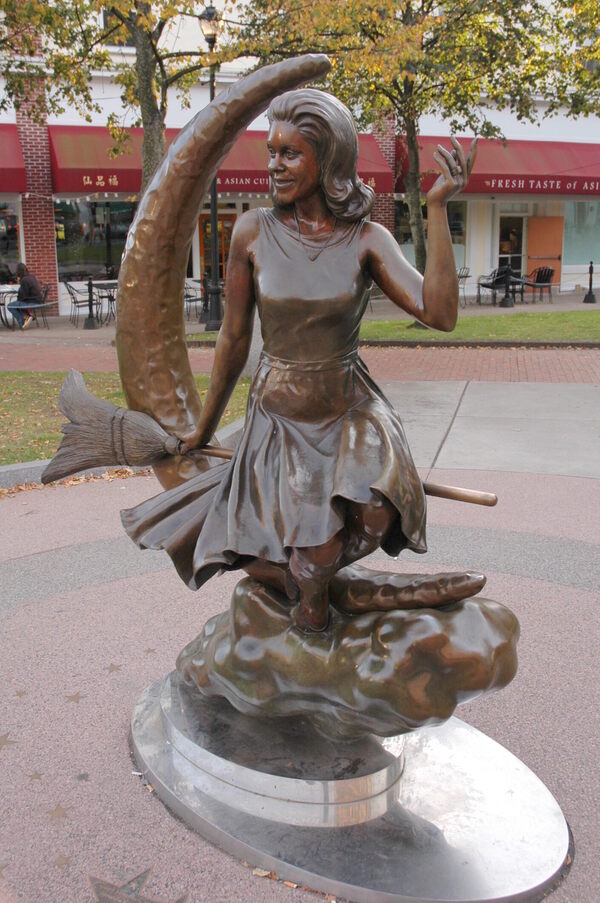
Statue of Samantha (Elizabeth Montgomery) from “Bewitched” in Salem. Source: Atlas Obscura.

At the intersection of Essex and Washington streets in Salem’s downtown area is a nine-foot-high bronze statue of a friendly-looking witch sitting on a broom. Installed in 2005, the statue honors Elizabeth Montgomery, the actress, and her television character, Samantha Stephens, a likeable suburban housewife and benign sorceress on the U.S. sitcom, Bewitched (1964-1972). In 1970, the crew and cast of the popular television show arrived in Salem to film some episodes, including one at the House of Seven Gables.

The installation of the statue proved to be controversial. Its local supporters presented it as a celebration of the connection, real and figurative, between the show and Salem, and as a booster of the city’s tourist economy. Meanwhile, its critics derided it for trivializing and commercializing the real-life (and death) drama involving those accused of witchcraft in the early 1690s, while serving as a crass advertisement for TV Land, the cable television company that built it. As one letter-to-the-editor writer stated in The Boston Globe, “If this statue is acceptable in Salem, why not have TV Land consider erecting a statue outside Auschwitz, honoring that funny and lovable German, Sergeant Schultz, a character on the TV series ‘Hogan’s Heroes’” (a comedy about U.S. POWs held in Germany during World War II).

In addition to obscuring the atrocities associated with the Salem Witch Trials*, the statue does not reveal that Montgomery was a progressive political activist. And her politics were manifest in the show at times: despite the comedic nature of Bewitched, one of its most famous episodes centered on racism and interracial marriage. Outside of the television studio, Montgomery was outspoken in her opposition to the Vietnam War and was a strong supporter of gay rights—in both cases well before it was fashionable to do so. She also narrated two documentary films highly critical of U.S. foreign policy in the 1980s: Coverup: Behind the Iran-Contra Affair (1988), and the Academy-Award-winning The Panama Deception (1992).

Getting there:

Commuter Rail from North Station (Newburyport/Rockport line) to Concord Station. About 0.2 miles (a 4-minute walk).

To learn more:

Kathy McCabe “’Bewitched’ statue plan bothers, bewilders,” The Boston Globe, April 28, 2005.

Jim McKairnes, “’Bewitched’ Broke Ground 45 Years Ago, USA Today, December 20, 2015.

Kathryn Miles, “Has Witch City Lost Its Way?” Boston Magazine, October 22, 2021.

Richard B. Trask, “Statue of TV witch makes light of past tragedies” (letter to the editor), The Boston Globe, June 26, 2005: D12.

*We discuss the Salem Witch Trials in our entry on Proctor’s Ledge in the Salem section of A People’s Guide to Greater Boston.

Mather Elementary School

1 Parish Street, Dorchester

Mather School, 1905. Source: Wikimedia Commons.

The Mather is the oldest public elementary and the first tax-supported school in the United States. It was founded in 1639 near the corner of what are today Cottage Street and Pleasant Street as a one-room schoolhouse. It remained there until 1694, when it moved about a half mile to Winter Street (the site of a fire station today) atop Meetinghouse Hill, Dorchester’s highest point–just yards from the school’s present location. It was then that the school was named after Richard Mather (Increase Mather’s father and Cotton Mather’s grandfather), a Congregational minister who settled in Dorchester in 1635. It is unclear when girls first attended the school, but in 1784, the town of Dorchester voted to allow females to do so and provide for their education.

In 2014, the Mather School marked its 375th birthday. Today, it is a school of great diversity, with students of African American, Cape Verdean, Haitian, Irish, and Vietnamese backgrounds. With many recently immigrated students of Vietnamese descent with limited English proficiency, the school runs a Vietnamese Sheltered Instruction program. 

The Mather is today housed in a building constructed in 1905. There is a beautiful view of the harbor and much of the city from the school’s grounds.

Getting there:

Red Line to Fields Corner station. 0.7 mile (15-minute) walk.

Nearby point of interest:

First Parish Church Dorchester (established in 1631, Unitarian Universalist), 10 Parish Street. The congregation, which founded the Mather School, has had a church on Meetinghouse Hill since the 1670s. The current building was constructed in 1897.

Joshua Bowen Smith Catering Business

City Hall Plaza (formerly 16 Brattle Street), Downtown

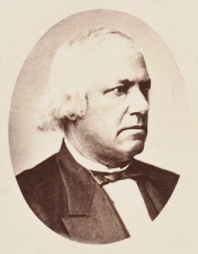
Photo of Joshua Bowen Smith cropped from a larger photo showing ten Massachusetts state representatives in 1874. Public domain.

In 1861, as Massachusetts rallied for the Civil War, abolitionist Joshua Bowen Smith, one of just five Black restaurateurs in the state, fed the state’s 12th Regiment for a period of three months, incurring a sizable outlay, $40,378. On presentation of the bill to the governor, John Andrew, himself an abolitionist, the state refused to pay. However, it did reimburse white restaurateurs. Such discrimination was the norm. According to a historian of the period, Black business people operated in “constant fear” that white clientele would not pay. Eight years later, following a lawsuit, Smith received partial compensation, insufficient however to save his business and rendering him indebted until his death in 1879.

Prior to those events, Smith grew a lucrative catering and then restaurant business serving both Harvard University and the abolitionist movement. His staff included formerly enslaved people, many living as fugitives from the South. Their employment was thus in defiance of federal law. Such a stance was consistent with Smith’s commitments. He was a leader of the Boston Vigilance Committee and founder of the New England Freedom Association, a fugitive slave assistance group founded by African Americans.

After the Civil War, Smith enjoyed enough public support to be win election to the state legislature in 1873. His many legislative activities included persuading the state to erect the Robert Gould Shaw Memorial across from the Massachusetts State House and advising his close friend Senator Charles Sumner on the federal Civil Rights Act of 1875.

Smith’s home at 79 Norfolk Street, Cambridge, is today part of that city’s African American Heritage Trail. Smith harbored people fleeing enslavement in his home, which served as stop on the Underground Railroad in the years preceding the Civil War.

Map of Scollay Square, circa 1851. Red area is center of the square. Source: And This Is Good Old Boston.

As for the former site of his catering business, the City of Boston eradicated Brattle Street as part of the larger razing of Scollay Square in 1962. The business would have stood on what is today the southern end of City Hall Plaza. In Smith’s time, the area was home to key institutions associated with the abolitionist movement. Located one block away, on Cornhill Street, for example, were the offices of the famed abolitionist newspaper, The Liberator, the Massachusetts Antislavery Society, and John P. Jewett and Company, publisher of Uncle Tom’s Cabin.

Getting there:

Blue Line or Green Line to Government Center station.

To learn more:

Kelly Erby, Restaurant Republic: The Rise of Public Dining in Boston. Minneapolis: University of Minnesota Press, 2016.*

Related site:

Smith is buried at the Mount Auburn Cemetery in Cambridge.

*The book mistakenly reports that Joshua Bowen Smith’s catering business was located on Brattle Street in Cambridge, instead of Boston.

Chestnut Hill Reservoir & the Metropolitan Waterworks Museum

2450 Beacon Street, Brighton

Pumping station of the Boston Water Works, Chestnut Hill Reservoir, circa late 1800s. Source: Arts Department, Boston Public Library via Digital Commonwealth.

The Chestnut Hill Reservoir, located at the western end of the city along the border with Brookline, opened in 1870 to help meet Boston’s water needs. Work on it began soon after the Civil War. With a capacity of 550,600,000 gallons, the reservoir greatly helped to relieve the pressure on Boston’s water system—at least for a while, particularly during a time of rapid population growth.

The reservoir was also noteworthy for the beauty of its grounds, constructed to allow for ambling in “nature” and, later, for its built infrastructure—particularly an 80-foot carriage road and greenway around the water body, a grand entrance arch connecting it to Beacon Street, and the pumping station (constructed in 1897). What the bucolic setting obscured was the arduous labor that went into constructing it.

Postcard of Chestnut Hill Reservoir pumping station and grounds, 1908. Source: Brookline Historical Society.

Built on the site was housing to accommodate for more than 400 workers, many of whom were Irish and Canadian immigrants or Civil War veterans. While the Cotichuate Water Board, which oversaw the project, claimed that its policy was to “pay our employés fair wages for their services, and have them well treated,” the workers perceived the wages as inadequate. On March 2, 1867, 225 workers, who were receiving $1.50 for their 12-to-14 hour-workdays, went on strike for higher pay. According to the Water Board, the workers “virtually proposed to supersede those in authority, and to fix their own wages…”  The Board promptly fired all the striking workers, the majority of whom they said had been misled by “a few restless, rambling men [who] were the leaders in the affair,” and quickly found replacement workers, whose wages were raised to $1.75 a day. That the Water Board was able to behave as it did suggests the weak bargaining position of workers at the time, a result of low levels of organization among many laborers and the presence of many in need of wage work.

The reservoir was taken offline in 1978, but it still serves as a backup water source in case of emergency. The architecturally grand pumping station on the reservoir’s edge is today home to the Metropolitan Waterworks Museum. The museum, entrance into which is free, interprets the history of Greater Boston’s water systems.

Getting there:

Green Line to Reservoir Station (D Line), or to Cleveland Circle Station (C Line). (0.4 miles, 8-minute walk.)

To learn more:

Boston Landmark Commission, Report of the Boston Landmark Commission on the Potential Designation of the Chestnut Hill Reservoir and Pumping Stations as a Landmark, City of Boston: Environment Department, Boston Landmark Commission, 1989.

William P. Marchione, “Water for Greater Boston,” Brighton Allston Historical Society, circa 1998-2001. (See also historical images of reservoir here.)

Report of the Cotichuate Water Board to the City Council of Boston for the Year 1866-67, City Document No. 88, Boston, 1867.

Hibernian Hall

182-186 Dudley Street, Roxbury

The Emerald Isle Orchestra, Hibernian Hall, 1939. Source: Digital Collections, Joseph P. Healey Library, UMass Boston.

Built in 1913, Hibernian Hall was an important center for Boston’s Irish community for almost fifty years. It hosted concerts of traditional Irish music, and contained a bowling alley, ballroom and many meeting rooms. Among other organizations, many local chapters of the Ancient Order of Hibernians, an Irish Catholic fraternal organization, which had its 19th century roots in combating discrimination against Irish immigrants, frequently took advantage of the space. So, too, did Boston’s largely Irish Catholic chapter of the Christian Front (see the entry on the Copley Square Hotel), an anti-Semitic organization, in the early 1940s.

In the initial decades of the 1900s, an influx of Jewish immigrants to Roxbury led to the Hall providing space for Bar Mitzvahs. In later years, the growing Black community in Roxbury led it to host James Brown and the Famous Flames before their rise to prominence. In a context in which many residents of Irish origin had moved out of Roxbury to other areas in Greater Boston and growing numbers of African Americans moved in, the Opportunities Industrialization Center bought the building in 1972. Started by Reverend Leon Sullivan of Philadelphia, the Center focused on providing technical and life skills training to the Black community.

In 2000, the Madison Park Development Corporation, a local community non-profit, purchased the Hall and relocated its offices there. The building’s 250-seat ballroom serves as the Roxbury Center for Arts at Hibernian Hall, a venue for theater, concerts, dances, film screenings, and private events.

Hibernian Hall, 2014. Photo by Eleni Macrakis.

Getting there:

Silver Line to Nubian Square station. Walk towards Dudley Street and turn left. Hibernian Hall is on the left side of the street. (0.2 miles, a 4-minute walk.)

To learn more:

Charles R. Gallagher, Nazis of Copley Square: The Forgotten Story of the Christian Front, Cambridge: Harvard University Press, 2021.

Gedutis, Susan. See You at the Hall: Boston’s Golden Era of Irish Music and Dance. Lebanon, NH: Northeastern University Press/University Press of New England, 2004.

Madison Park Development Corporation. “Hibernian Hall 100th Anniversary Video, Dudley Square, Roxbury, 1913-2013,” posted on YouTube on October 11, 2013.